

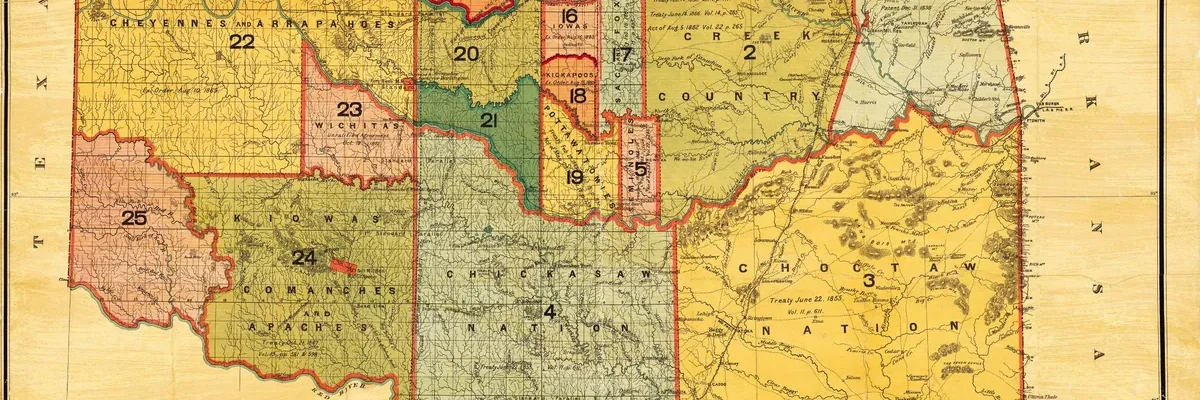
Mineral Title on Oklahoma Tribal Lands
Restricted Interests and the Stigler Act
Published October 15, 2026 | Reading Time: 17 minutes
Much of Oklahoma’s land, and the minerals beneath it, traces back to an allotment made to a tribal citizen more than a century ago. For most of those tracts, the Indian origin of the title is a historical footnote. For others, it is a live legal fact that controls who can sign a lease, how an estate must be probated, and whether a deed is valid at all. A conveyance of a restricted Indian interest that skips the required federal or court approval is not just defective. It is void.
The stakes grew in 2018, when Congress amended the Stigler Act to remove the blood quantum requirement that had caused restricted land of the Five Tribes to lose its protected status as it passed from generation to generation. Restricted interests that once would have become ordinary fee title now stay restricted as they pass to lineal descendants. This guide explains how Indian land title works in Oklahoma, what the Stigler Act and its 2018 amendments require, how restricted and trust interests affect oil and gas leasing and probate, and how title examiners, operators, and mineral owners can spot and handle these interests.
💡 The Short Answer
Oklahoma has three main kinds of Indian land title: unrestricted fee land, which is treated like any other land; restricted land of the Five Tribes, which the owner holds but cannot convey or lease without approval in Oklahoma district court under the Stigler Act; and trust land of other Oklahoma tribes, including the Osage, where the United States holds title and the Bureau of Indian Affairs approves leases. Since the 2018 Stigler Act amendments, restricted Five Tribes land stays restricted when it passes to any lineal descendant by blood of an original enrollee, regardless of blood quantum. Probates involving restricted property require timely notice to the Bureau of Indian Affairs, and conveyances made without the required approvals are void.Table of Contents
- How Indian Land Became Private Title
- Three Kinds of Indian Land Title
- The Stigler Act of 1947
- The 2018 Stigler Act Amendments
- What Restricted Status Means for Title and Leasing
- Probate of Restricted Estates
- Trust Allotments of Other Oklahoma Tribes
- The Osage Mineral Estate
- Does McGirt Change Land Title?
- Oklahoma Specific Considerations
- Frequently Asked Questions
- Getting Indian Title Right
How Indian Land Became Private Title
In the late 1800s, federal policy shifted from tribal ownership of land to individual ownership. The General Allotment Act of 1887, known as the Dawes Act, divided many reservations into individual allotments. The Five Tribes, the Cherokee, Chickasaw, Choctaw, Muscogee (Creek), and Seminole Nations, were initially excluded, but the Curtis Act of 1898 and later agreements brought allotment to their lands as well. Federal statutes and older title records call them the “Five Civilized Tribes,” and older materials sometimes contrast them with the other tribes of western Oklahoma using labels that are no longer in use. This guide refers to the Five Tribes and to other Oklahoma tribes, including the Osage.
The Dawes Commission enrolled tribal citizens and allotted land to each enrollee. The resulting Dawes Rolls, held by the National Archives, remain essential title records today. According to Interior Department testimony to Congress, about 15.8 million acres had been allotted to Five Tribes citizens by 1916.
Congress placed restrictions on many of those allotments, barring their sale for years, and then lifted them in stages based on blood quantum. The Oklahoma Historical Society’s history of restriction removals explains how the 1908 Act removed restrictions from enrollees with less than one half blood and kept the rest restricted, and how owners could apply to have restrictions removed. By 2012, only about 381,474 acres, less than 2 percent of the original Five Tribes allotments, remained restricted.
Three Kinds of Indian Land Title
📊 Indian Land Title in Oklahoma at a Glance
Unrestricted fee. Land that has lost its restricted status. It is bought, sold, leased, and probated like any other Oklahoma land. Most former allotments fall here.Restricted fee (Five Tribes). The Indian owner holds title, but cannot sell, lease, mortgage, or partition the land without approval under the Stigler Act. Generally exempt from state property tax, subject to limits.
Trust (other tribes and some Five Tribes land). The United States holds legal title for the benefit of the tribe or individual. The Bureau of Indian Affairs approves leases, and federal agencies manage royalty collection and probate.
Telling these apart is the first job in any title examination of former Indian land. County records alone may not reveal whether an interest is restricted or held in trust, so examiners often need tribal enrollment records, Bureau of Indian Affairs records, and earlier court orders to trace the status of each interest.
The Stigler Act of 1947
The Act of August 4, 1947, known as the Stigler Act, governs restricted land of the Five Tribes. Before 2018, it continued restrictions only for heirs and devisees with at least one half Five Tribes blood. When restricted land passed to an heir with less blood quantum, the restriction ended and the land became unrestricted fee.
For restricted owners, the Act requires court approval of conveyances. A deed, lease, or other conveyance of restricted land inherited from an original allottee is void unless approved in open court in the county where the land is located. The Act originally named the county court; today that approval is given by the Oklahoma district court. The process includes:
- A petition filed with the court where the land lies
- Notice to the Interior Department attorneys who represent restricted Indians
- An appraisal or other evidence that the consideration is fair
- Published notice, so other buyers or lessees can bid
- A hearing in open court and an order approving the conveyance
The Act also requires notice to the Bureau of Indian Affairs in probate proceedings involving restricted property and allows the United States to remove certain cases to federal court. The Oklahoma Bar Journal’s analysis of the Stigler Act amendments, written by an Interior Department attorney, is the best single overview of how the process works.
⚠️ Skipping the Approval Makes the Conveyance Void
A deed, mineral deed, or oil and gas lease of a restricted Five Tribes interest that was not approved as the Stigler Act requires does not just create a curable defect. It is void. No amount of time, payment, or recording fixes it. A missed restriction can surface decades later, when a buyer’s or operator’s title examiner traces the chain back to an unapproved conveyance.The 2018 Stigler Act Amendments
On December 31, 2018, the Stigler Act Amendments of 2018 (Public Law 115-399) became law with a single goal: eliminating the blood quantum requirement. The Senate committee report explains that restricted land had been steadily lost as it passed to heirs with less than one half blood, and that the Five Tribes and their inter tribal council supported the change.
What Changed
- No blood quantum. Restricted status now continues for any lineal descendant by blood of an original enrollee on the final Indian rolls of the Five Tribes, of whatever degree of Indian blood.
- Freedmen and intermarried rolls. Descendants of enrollees on the freedmen or intermarried rolls do not qualify unless they also descend by blood from an enrollee on the final Indian rolls.
- More ways to acquire restricted land. Restricted status continues for interests acquired by inheritance, devise, gift, exchange, partition, and, newly, by purchase and partition sale.
- Same approval process. The court approval procedures for conveyances, heirship determinations, probate, partition, and quiet title did not change.
What Did Not Change
The amendments work going forward. They do not restore restricted status to land that already lost it because it passed to an heir with less than one half blood before the amendments. Oil and gas leases taken from owners with less than one half blood without court approval before the amendments remain valid for their duration. But restricted property in the estate of someone who died before the amendments and whose estate is probated afterward can pass to heirs in restricted status regardless of their blood quantum.
⚠️ Interests That Would Have Become Unrestricted Now Stay Restricted
Before 2019, an examiner could often conclude that a restricted interest became unrestricted when it passed to an heir with less than one half blood. That shortcut no longer works. An interest inherited or acquired after the amendments by any lineal descendant of an original enrollee may still be restricted, and a lease or deed from that owner may need court approval. Title opinions and lease programs written under the old rule should be revisited.What Restricted Status Means for Title and Leasing
Identifying Restricted Interests
Determining whether an interest is restricted requires tracing each owner back to the original allottee. The key questions are whether the original allottee was enrolled on the final Indian rolls, whether restrictions were removed during the allottee’s lifetime, how each later owner acquired the interest and when, and whether each later owner is a lineal descendant by blood of an original enrollee. The Oklahoma Historical Society maintains a searchable index of restriction removal records, and the National Archives holds the enrollment cards and allotment files.
✅ Red Flags for Restricted or Trust Interests
- A chain of title beginning with an allotment patent or allotment deed
- Prior conveyances approved by a county or district court order
- Probate proceedings with notice to the Bureau of Indian Affairs or an Interior Department attorney
- Owners who are citizens of one of the Five Tribes and descend from an original enrollee
- Land exempt from county property tax
- Leases approved by the Bureau of Indian Affairs or royalties paid through federal accounts
- Gaps in the county record where an Indian owner died
Leasing Restricted Interests
An oil and gas lease is a conveyance, so a lease of a restricted Five Tribes interest generally requires approval through the Stigler Act process in the district court of the county where the land lies. In a tract with many heirs, some interests may be restricted and others not. Unrestricted owners can lease in the usual way, while restricted owners’ leases need approval. Our guide to Oklahoma oil and gas leases covers the lease terms themselves.
A 2026 Example: Pope v. United States
A recent federal case shows how these leases work in practice and where they can go wrong. In Pope v. United States, decided by the U.S. Court of Federal Claims in April 2026, descendants of an original allottee owned interests in an 80 acre restricted allotment in Pittsburg County. In 2022, the district court approved a lease of restricted interests, but only 20 of the 84 mineral owners ultimately leased, and some owners disputed the bonus they had been told to expect. The court dismissed their claims against the United States, holding that the Stigler Act does not impose the broad trust duties the owners alleged and that owners who did not lease remain cotenants under Oklahoma law with remedies in state court. The decision is a reminder that the Stigler Act process protects restricted owners, but it does not manage their interests for them.
Partition and Quiet Title
Restricted interests are often held by dozens of heirs, which leads to partition and quiet title actions. When restricted land is involved, the United States must receive notice and may remove the case to federal court. Judgments entered without proper notice may not bind the restricted interests.
Probate of Restricted Estates
Estates of Five Tribes citizens that include restricted property are probated in Oklahoma district court, but with a federal overlay. Written notice of the proceeding must be served on the Regional Director of the Bureau of Indian Affairs’ Eastern Oklahoma Regional Office. The Oklahoma Title Examination Standards treat a failure to give that notice as jurisdictional, leaving the proceeding void as to the restricted property and not binding on the United States. Notice served late, after the 10 day window following the filing, is treated as a procedural defect that can be waived.
For final orders entered after December 31, 2018, the notice requirement applies to restricted property regardless of the decedent’s blood quantum. Heirship shortcuts that work for unrestricted minerals, such as an affidavit of heirship, may not be enough when restricted interests are involved. Our guides to heirship affidavits and curative title and ancillary probate for out of state mineral owners explain the general process, and our article on inheriting oil and gas rights covers what heirs should do first.
Trust Allotments of Other Oklahoma Tribes
Oklahoma is home to 38 federally recognized tribes. Many tribes in central and western Oklahoma, such as the Kiowa, Comanche, Apache, Cheyenne and Arapaho, Wichita, and Caddo, received allotments held in trust by the United States rather than restricted fee allotments. That difference changes almost everything about how the minerals are handled.
- Leasing. Leases of trust minerals require Bureau of Indian Affairs approval under federal regulations. The BIA’s mineral leasing overview describes how the Bureau of Land Management, the Office of Natural Resources Revenue, and other agencies share the work.
- Royalties. Operators report and pay royalties on trust minerals to the Office of Natural Resources Revenue, which distributes them to the owners. The Interior Department’s guide to production on Native American land explains the process.
- Probate. Trust estates are generally probated by the Interior Department, not by Oklahoma courts.
- Records. Title to trust land is kept in federal land title records, and county records may be incomplete.
💡 Restricted Is Not the Same as Trust
The two terms are often used interchangeably, but they are not the same. A restricted Five Tribes owner holds title and needs state court approval to convey it. A trust owner holds a beneficial interest while the United States holds legal title, and federal agencies approve leases and handle probate. Applying the wrong framework to an interest is one of the most common errors in Indian title work.The Osage Mineral Estate
Osage County stands apart. When the Osage reservation was allotted in 1906, Congress reserved the entire mineral estate to the tribe. As the Osage Nation explains, the United States holds the Osage Mineral Estate in trust for the Nation, and no individual owns the minerals. Instead, holders of headrights receive quarterly payments from mineral revenue. About 25 percent of headrights are held by non Osages.
The practical result is that surface owners in Osage County generally do not own the oil and gas beneath their land, and leasing is handled through the Osage Minerals Council and the Bureau of Indian Affairs’ Osage Agency rather than through individual landowners or the Corporation Commission’s usual pooling process. Headrights themselves pass at death and can raise their own probate and title questions.
Does McGirt Change Land Title?
In 2020, the Supreme Court held in McGirt v. Oklahoma that the Muscogee (Creek) reservation was never disestablished for purposes of federal criminal law, and later decisions applied the same reasoning to other reservations of the Five Tribes. McGirt addressed criminal jurisdiction. It did not change who owns land or minerals, convert fee land into trust land, or alter the restricted status of any interest. The restricted and trust rules discussed in this guide come from the allotment statutes and the Stigler Act, and they apply regardless of reservation status.
Oklahoma Specific Considerations
Indian land title is uniquely Oklahoma. No other state has the same combination of Five Tribes restricted fee allotments, trust allotments of dozens of other tribes, and a tribal mineral estate covering an entire county. Mineral owners, heirs, and operators dealing with these interests can work with our Oklahoma oil and gas title attorneys.
- District court approvals. Stigler Act approvals are handled county by county in Oklahoma district court, with notice to Interior Department attorneys.
- Title Examination Standards. Oklahoma’s Title Examination Standards address the Bureau of Indian Affairs notice requirement for probates involving restricted property, including the post 2018 rule.
- Homestead overlap. Oklahoma law provides that federal laws do not deprive Indian allottees of state homestead protections. Our guide to Oklahoma homestead rights covers how those rights affect leases and probate.
🧭 Oklahoma Indian Title Quick Reference
- Five Tribes restricted land: owner holds title; conveyances and leases need Stigler Act court approval
- Since December 31, 2018: restrictions continue for lineal descendants by blood of original enrollees, regardless of blood quantum
- Land that lost restricted status before 2019 stays unrestricted
- Probates with restricted property: written notice to the BIA Eastern Oklahoma Regional Office
- Trust allotments of other tribes: BIA approves leases; federal agencies handle royalties and probate
- Osage County: minerals belong to the Osage Mineral Estate, not the surface owner
🚀 Restricted or Trust Interests in Your Chain of Title?
Indian title mistakes do not cure with time.
We examine Oklahoma mineral titles that trace to allotments, identify restricted and trust interests, and handle the approvals and probate steps needed to lease, sell, or inherit them.
- Title examination and opinions on former allotments
- Stigler Act approvals for leases and conveyances
- Probates and heirship involving restricted property
- Curative title for restricted and trust interests
Confidential consultation • Prompt response • Oklahoma oil and gas title
Frequently Asked Questions
-
What is restricted Indian land in Oklahoma?
Land of a Five Tribes citizen that the owner holds but cannot sell, lease, or mortgage without approval under the Stigler Act. It is distinct from trust land, where the United States holds title.
What did the 2018 Stigler Act amendments change?
They removed the one half blood quantum requirement. Restricted land now stays restricted when it passes to any lineal descendant by blood of an original enrollee on the final Indian rolls.
Do the 2018 amendments apply to land that already lost restricted status?
No. They apply going forward and do not restore restrictions to land that became unrestricted before December 31, 2018.
Who approves a lease of restricted Five Tribes minerals?
The Oklahoma district court in the county where the land lies, through the Stigler Act process, with notice to Interior Department attorneys.
What happens if a restricted interest is conveyed without approval?
The conveyance is void, and the defect does not cure with time or recording.
Does a probate involving restricted property need federal notice?
Yes. Written notice must go to the Bureau of Indian Affairs Eastern Oklahoma Regional Office. Failing to give notice leaves the proceeding void as to the restricted property.
Can an affidavit of heirship transfer restricted interests?
Heirship affidavits that work for unrestricted minerals may not be sufficient for restricted interests, which often require a court proceeding with proper federal notice.
How are trust minerals of western Oklahoma tribes leased?
The Bureau of Indian Affairs approves leases, and the Office of Natural Resources Revenue collects and distributes royalties.
Do surface owners in Osage County own their minerals?
Generally no. The minerals belong to the Osage Mineral Estate, held in trust for the Osage Nation, and revenue is paid to headright holders.
Did McGirt change who owns minerals in eastern Oklahoma?
No. McGirt addressed criminal jurisdiction. It did not change land or mineral ownership or the restricted status of any interest.
How do I find out if my minerals are restricted?
Trace the chain of title to the original allotment, check enrollment and restriction records, and review prior court orders and probates. A title examination is usually needed.
Getting Indian Title Right
Indian land title is where Oklahoma’s history meets its present day oil and gas business. Restricted and trust interests follow rules that override ordinary Oklahoma property law, and the 2018 amendments mean more interests will stay restricted for generations. For mineral owners, the lesson is to understand your status before you lease, sell, or plan your estate. For operators and buyers, it is to verify status for every owner, not just the ones who look like they might be restricted.
For broader context on Oklahoma mineral decisions, see our guide to leasing, pooling, selling, or holding Oklahoma minerals.
Disclaimer: This article provides general information about Indian land and mineral title in Oklahoma and is not legal advice. Restricted and trust status depends on the specific history of each interest, federal statutes and regulations, and tribal records, and the rules continue to be interpreted by state and federal courts. Laws change and every situation turns on its own facts. For guidance on your specific situation, consult qualified Oklahoma counsel.
About Cantrell Law Firm: We are Oklahoma attorneys who examine and cure oil and gas titles, including titles involving restricted and trust Indian interests. Learn more about our oil and gas title practice. Contact us to discuss your title.