

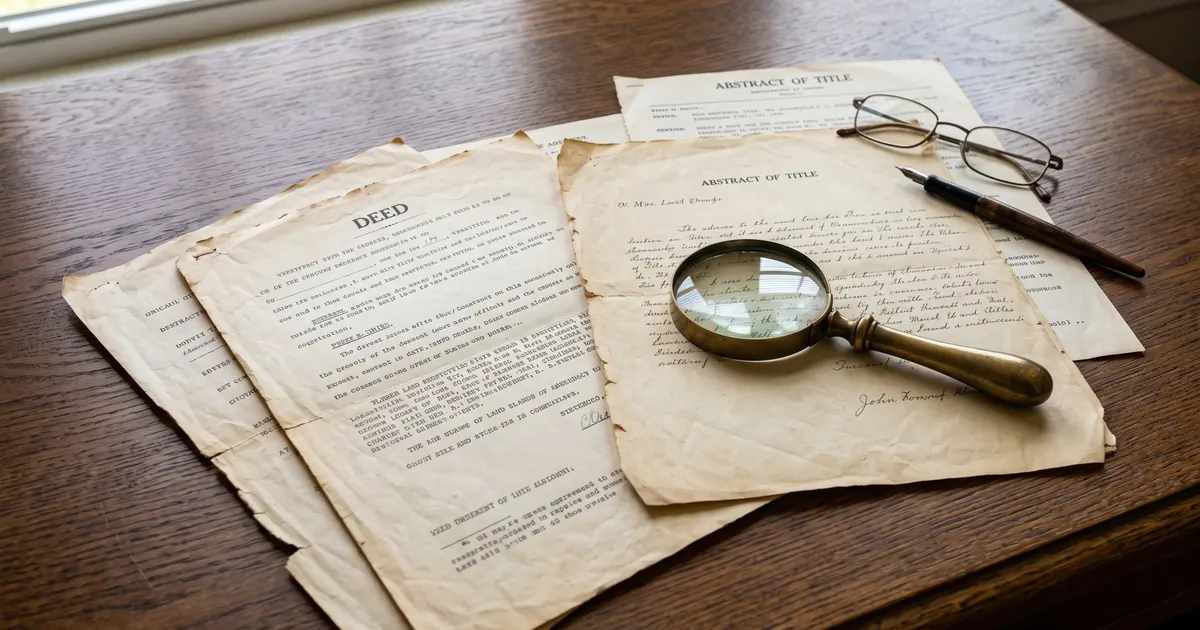
Heirship Affidavits and Curative Title
A Guide for Oklahoma Mineral Owners
Updated October 24, 2026 | Reading Time: 21 minutes
An oil company is ready to pay royalties on a new well, but your share is sitting in suspense. The letter says the operator’s title opinion has a “requirement” that must be satisfied first, and it mentions an affidavit of heirship, a probate decree, or something called curative. You are not sure what any of that means, why your grandmother’s minerals are not simply yours, or which option is fastest.
Oklahoma mineral title is complicated for a reason. Minerals were severed from the surface generations ago, then divided among children and grandchildren every time an owner died, often without a probate. Before an operator pays anyone, a title examiner traces every interest back through the county records and lists each gap that needs to be filled. Filling those gaps is called curative title work, and the affidavit of death and heirship is the most common, and most misunderstood, tool for doing it.
This guide explains how heirship affidavits work in Oklahoma, the ten year rule that limits them, when an affidavit is enough and when it is not, the other curative tools available, and how to decide which path fits your family’s interest.
💡 The Short Answer
An affidavit of death and heirship is a sworn statement, recorded in the county where the minerals lie, that identifies who died, when, and who their heirs are. In Oklahoma it is inexpensive and fast, and some operators will release royalties based on it, especially for smaller interests. But an affidavit does not create marketable title until it has been of record for ten years without any conflicting document. For selling minerals, larger interests, wills that change the inheritance, or disputed families, a probate decree or a quiet title judgment is usually needed instead. Curative title is the broader process of clearing every defect a title examiner identifies, using affidavits, recorded instruments, and court orders.Table of Contents
- Why Oklahoma Mineral Title Gets Cloudy
- Title Opinions and Curative Requirements
- What an Affidavit of Death and Heirship Is
- The Ten Year Rule
- When an Affidavit Is Enough, and When It Is Not
- Common Title Defects in Inherited Minerals
- The Curative Toolkit
- Working With Operators: Suspense and Division Orders
- Choosing the Right Path
- Oklahoma Specific Considerations
- Frequently Asked Questions
- Clear Title Is an Asset
Why Oklahoma Mineral Title Gets Cloudy
Mineral ownership in Oklahoma tends to fragment over time. A farmer who owned all the minerals under a quarter section in 1940 may have reserved them when he sold the surface. When he died, his minerals passed to his widow and children. When each of them died, their shares passed again. Eighty years later, the same minerals can be owned by dozens of people, some with interests so small they produce a few dollars a month.
Every one of those transfers needs to show up in the county records for the title to be clear. When a death was never probated, when a divorce decree was never recorded, when a deed used a misspelled name, or when an old mortgage was never released, the chain of title has a gap. Those gaps often go unnoticed for decades, until a new well is drilled and the operator’s title examiner works through the records. Our guide to inheriting oil and gas rights covers the inheritance side in more depth.
Title Opinions and Curative Requirements
Before drilling, and again before paying royalties, operators hire Oklahoma attorneys to examine the title to every interest in the drilling unit. Landmen, described by the American Association of Professional Landmen, gather the records; the examining attorney reviews them and issues a written title opinion. A drilling title opinion comes before the well is drilled. A division order title opinion comes before production payments begin, and it sets out each owner’s decimal interest in the well.
Each opinion lists “requirements,” which are the specific gaps or defects the examiner wants cured before treating an owner’s title as marketable. Requirements might ask for a probate decree, an affidavit of heirship, a recorded release, a corrected deed, or a court judgment. Until a requirement affecting your interest is satisfied, or the operator decides to waive it, your share is typically held in suspense.
The Standard Examiners Apply
Oklahoma examiners judge title against the Oklahoma Title Examination Standards, adopted by the Oklahoma Bar Association. As the Oklahoma Bar Journal explains, the standards have guided examiners since 1946, and Oklahoma’s royalty payment law requires that marketability be determined under the then current standards. Marketable title means title free from apparent defects, grave doubts, and litigious uncertainty. That is a demanding standard, and it is why a family that has never doubted who owns the minerals can still be told its title is not marketable.
⚠️ “Everyone Knows Who Owns It” Is Not Title
Family knowledge, an obituary, or a home state probate does not satisfy an Oklahoma title requirement. The examiner can only rely on what is recorded in the county where the minerals lie or established by a court order. Until the record says who owns the interest, the operator is generally entitled to hold the money.What an Affidavit of Death and Heirship Is
An affidavit of death and heirship is a sworn statement, signed before a notary and recorded with the county clerk, that sets out the facts needed to identify a deceased owner’s heirs. Oklahoma’s affidavit of heirship statute lets heirs use it to establish title to severed mineral interests without a probate, subject to the limits described below.
What It Contains
A proper heirship affidavit tells the family’s whole story as it bears on the minerals: who died and when, whether there was a will, every marriage and child, any heir who has since died, and exactly which minerals are covered. A gap or mistake in any one of those facts can leave the title requirement unsatisfied, and a corrected affidavit generally restarts the ten year clock. Our oil and gas title attorneys prepare heirship affidavits built to satisfy the examiner the first time.
Who Can Sign
The person signing must have personal knowledge of the family facts. In Oklahoma, a family member, including an heir, can sign. That differs from Texas, which generally expects disinterested witnesses for its heirship affidavits. Many examiners prefer an affidavit from someone with no financial interest, or a second supporting affidavit, because a disinterested witness carries more weight if the facts are ever questioned.
Where It Is Recorded
An heirship affidavit only helps in a county where it is of record, so an affidavit for one county does nothing for minerals in another. Families with minerals in several counties often need several recordings, and it is worth knowing whether a relative already recorded one years ago, since an older affidavit may already be close to the ten year mark. Checking the records in every county is part of how we plan curative.
The Ten Year Rule
The most important limit on heirship affidavits is time. Under Oklahoma law, an affidavit of death and heirship supports marketable title only after it has been of record for at least ten years, with no instrument inconsistent with it recorded during that period. Until then, the heirs’ title can be challenged by a later probate, an omitted heir, or a will that surfaces.
That rule has practical consequences:
- A recent affidavit is a start, not a finish. Recording one today helps operators and lessees, but a buyer’s examiner will likely still require a probate or other curative before treating the title as marketable.
- Old affidavits can be valuable. An affidavit a relative recorded fifteen years ago, with nothing inconsistent recorded since, may already provide marketable title for that link in the chain.
- Mistakes restart the clock. An affidavit that has to be corrected generally starts a new ten year period from the corrected filing.
- Notice concerns remain. Commentators have noted that recorded notice alone does not give heirs the formal notice a probate provides, which is one reason examiners treat affidavits cautiously on larger interests.
📊 How Inherited Interests Get So Small
Suppose a grandparent owned 10 net mineral acres in a 640 acre drilling unit, subject to a 3/16 royalty. Their decimal interest in the well was 10 ÷ 640 × 3/16, or about 0.00293. If that interest passed to four grandchildren equally, each owns about 0.00073 of the well’s production. At those sizes, the cost of a full probate can approach the value of the interest, which is why affidavits are so common, and why many operators accept them for small payments. Tiny decimals across many wells are also easy to lose track of, which is where our mineral management service helps.When an Affidavit Is Enough, and When It Is Not
There is no single right answer. The Oklahoma Bar Journal’s discussion of affidavits used in place of probate notes that the strict marketability requirements can limit an heir’s ability to sell, and sometimes even to lease, which can make probate the better choice. The table below summarizes the usual considerations.
| Situation | Affidavit Often Works | Court Order Usually Needed |
|---|---|---|
| Size of interest | Small royalty interests with modest income | Larger interests or significant suspended funds |
| Goal | Release royalties and keep receiving them | Selling the minerals, or a lessee that requires marketable title |
| Will | No will, or a will consistent with the intestate result | A will that changes who inherits, and was never probated |
| Family | Clear family history and agreement among heirs | Disputes, missing heirs, minors, or uncertain parentage |
| Timing | An affidavit already recorded for ten years | A recent death with possible creditors |
| Operator | Operator confirms it will accept an affidavit | Operator’s requirement specifically calls for a decree |
When a court order is needed, the most efficient route is often summary administration, which is available for estates of people who have been dead more than five years, people who lived outside Oklahoma, and estates worth $300,000 or less. For heirs who live in other states, our guide to ancillary probate for out of state mineral owners explains the options, and our guide to how long probate takes in Oklahoma covers timing.
Common Title Defects in Inherited Minerals
Missing probates are the most common defect, but they are rarely the only one. Examiners frequently raise these requirements on inherited minerals:
- Unprobated deaths. An owner of record died, and nothing in the records transfers the interest to the heirs.
- Several generations of unprobated deaths. Each death in the chain needs its own proof, and sometimes its own proceeding.
- Unrecorded divorces. A former spouse appears to own an interest because the divorce decree that awarded it was never recorded in the county.
- Name variations. “Mary Smith,” “M. A. Smith,” and “Mary Ann Jones Smith” may be the same person, but the examiner needs an affidavit of identity to say so.
- Old mortgages and leases. A mortgage from decades ago, or an expired oil and gas lease, was never released of record.
- Trust gaps. Minerals were deeded to a trust, but the trustee’s authority, a successor trustee’s appointment, or the trust’s termination was never documented in the records.
- Ambiguous deeds. An old deed conveys “one half of the royalty” or uses a fraction that can be read more than one way, leaving the owners’ shares uncertain.
- Older estates. For deaths before 2010, when Oklahoma still had an estate tax, examiners may look for evidence that the tax was resolved.
- Dissolved companies. An entity that once owned the interest no longer exists, and no one documented where its minerals went.
The Curative Toolkit
Curative title work uses three kinds of tools. Choosing among them is the core judgment in any curative project.
Recorded Instruments
Many defects can be cured by recording the right document: an affidavit of death and heirship, an affidavit of identity, a release of an old mortgage or lease, a corrected or confirmatory deed, a recorded divorce decree, or a certificate showing a trust’s terms and trustee. These are the fastest and least expensive tools, but they only work when the facts are clear and the people who need to sign are available.
Agreements Among Owners
When the problem is uncertainty rather than a missing record, the owners themselves can often resolve it. A stipulation of interest is a recorded agreement among all affected owners about how an ambiguous interest is shared. A ratification can confirm an earlier deed or lease that had a technical flaw. Agreements work well in families that cooperate, and poorly when even one owner refuses or cannot be found.
Court Orders
When records and agreements cannot do the job, a court order provides the strongest cure:
- Probate decree. A regular, summary, or ancillary probate produces a decree identifying the heirs or beneficiaries and transferring title. It is the cure most examiners prefer for unprobated deaths.
- Quiet title judgment. A quiet title action is a lawsuit that asks the court to declare who owns the property and to cut off competing claims. Unknown heirs and owners who cannot be found can be served by publication. Quiet title is often the answer for old, tangled chains, ambiguous deeds, and missing owners, and in some cases it can establish heirship without a probate.
| Tool | Typical Use | Speed | Strength |
|---|---|---|---|
| Heirship affidavit | Small interests, clear families | Days to weeks | Limited until of record ten years |
| Other recorded instruments | Releases, identity, corrections | Days to weeks | Strong for the specific defect |
| Stipulation or ratification | Ambiguous fractions, flawed deeds | Weeks, if everyone signs | Strong among those who sign |
| Probate decree | Unprobated deaths | About 2 to 6 months | Strong; preferred by examiners |
| Quiet title judgment | Tangled chains, missing owners | Several months | Strong against all parties served |
💡 Fix the Whole Chain at Once
Families often cure one requirement for one well, then face a new requirement on the next well, or when they try to sell. If a probate or quiet title action is needed anyway, it usually makes sense to cover every Oklahoma interest and every unprobated death in the chain in the same proceeding. One well planned cure is cheaper than several partial ones.Working With Operators: Suspense and Division Orders
Suspended Funds
When title to your interest has an unsatisfied requirement, the operator typically places your share in suspense. Suspense is not permanent. Starting November 1, 2026, Oklahoma’s new royalty payment law stops interest while a probate is required to clear title, until the payor receives the file stamped final decree. Money held for that reason is to be sent to the State Treasurer’s new Mineral Owner’s Fund within 180 days, proceeds unpaid for 36 months can also go to the fund, and unclaimed mineral proceeds are presumed abandoned after 36 months instead of five years. Money that reaches the state, whether in the fund or the unclaimed property program, can still be claimed, but only with the same proof of ownership the operator would have required. Our HB 1371 guide explains the changes.
Division Orders
A division order is the operator’s statement of each owner’s decimal interest in a well, which the owner signs to confirm the interest and receive payment. Under Oklahoma law, a division order is not supposed to change the terms of your lease, but it is still worth checking the decimal, the legal description, and the name before signing. A decimal that looks wrong often signals a title problem the operator’s examiner resolved in a way you would not have. Checking a decimal means tying it back to your title, the unit size, and the spacing orders at the Oklahoma Corporation Commission. Our mineral management service reviews new division orders against your title and the Commission records before you sign, and flags any decimal that does not match.
Know What Each Operator Will Accept
Operators differ on what they will accept. Some release smaller interests on an affidavit of heirship, while others want a court decree no matter the size, and the same family may face different answers from different operators. Before any curative is prepared, we confirm each operator’s position on your interest so the plan satisfies every requirement once.
Choosing the Right Path
The right curative plan depends on a handful of questions. Working through them before recording anything avoids paying for the same fix twice.
✅ Questions That Decide the Path
- How large is the interest, and how much is in suspense?
- Do you plan to keep the minerals, lease them, or sell them?
- Did the decedent leave a will, and was it ever probated?
- How many unprobated deaths are in the chain, and how long ago did they occur?
- Are any heirs missing, minors, incapacitated, or in disagreement?
- Has anyone already recorded an affidavit, and how long ago?
- How many counties and operators are involved, and what will each accept?
Answering these questions starts with knowing everything the family owns. Our mineral portfolio audit identifies every interest, every operator, and every requirement holding up payment, so the curative plan covers the whole chain at once.
If you are leaning toward selling, cure first or price the defect in. Buyers discount minerals with title problems, sometimes heavily, because they assume the cost and risk of curing them. Our article on whether to sell, lease, or hold Oklahoma minerals covers that decision, and the IRS explains how inherited property generally receives a basis equal to its value at the date of death, which affects the tax on a sale. If you are leasing, our oil and gas lease guide explains what lessees look for.
Oklahoma Specific Considerations
Oklahoma has its own tools for mineral title that most states do not: an affidavit of heirship statute aimed specifically at severed minerals, a royalty payment law that ties marketability to the Bar’s title standards, and county by county recording that makes every interest traceable but every gap visible. Using those tools well takes both probate experience and title experience. Our Oklahoma oil and gas title attorneys examine mineral title, prepare curative, and help heirs and operators satisfy title requirements so suspended royalties can be paid.
When curative calls for a court order, our probate team handles summary, ancillary, and full administration, and we advise heirs on leases and offers through our mineral rights practice. Mineral owners looking for education and advocacy can also turn to the Oklahoma chapter of the National Association of Royalty Owners.
🧭 Oklahoma Mineral Title at a Glance
- Minerals are real property; title runs through the county clerk’s records in each county
- Examiners apply the Oklahoma Bar Association’s Title Examination Standards
- Heirship affidavits may be signed by a family member with personal knowledge
- An affidavit supports marketable title only after ten years of record with nothing inconsistent filed
- Summary administration is available for nonresidents, deaths more than five years ago, and estates up to $300,000
- From November 1, 2026, unclaimed mineral proceeds are presumed abandoned after 36 months, and held proceeds can go to the State Treasurer’s Mineral Owner’s Fund
🚀 Royalties Held Up by a Title Requirement?
Find the fastest cure that will actually hold.
We review the title requirement, the county records, and your family’s history, then recommend the most efficient way to clear title, whether that is an affidavit, a recorded instrument, a probate, or a quiet title action.
- Mineral portfolio audits
- Affidavits of death and heirship
- Curative title for operators and mineral owners
- Summary and ancillary probate for mineral estates
- Quiet title actions
- Ongoing mineral management once title is clear
Confidential consultation • Prompt response • Oklahoma oil and gas title
Frequently Asked Questions
-
What is an affidavit of heirship for oil and gas in Oklahoma?
It is a sworn statement recorded in the county where minerals are located that identifies a deceased owner, their family, and their heirs. Oklahoma law allows heirs to use it to establish title to severed minerals without probate, subject to a ten year waiting period before it supports marketable title.
Who can sign an affidavit of heirship in Oklahoma?
Someone with personal knowledge of the deceased person’s family history. Oklahoma does not require the signer to be disinterested, so a family member or heir can sign, though some examiners prefer a supporting affidavit from someone without a financial stake.
Will an operator pay royalties based on an heirship affidavit?
Often, for smaller interests. Each operator sets its own policy, and some require a probate decree regardless of size. Confirming each operator’s position before anything is recorded avoids paying for the same fix twice, and it is the first thing we do in a curative project.
Can I sell inherited minerals with only an affidavit of heirship?
Sometimes, but buyers and their examiners usually want marketable title. Unless the affidavit has been of record for ten years with nothing inconsistent filed, a buyer will typically require a probate or quiet title, or reduce the price to account for the risk.
What is curative title?
It is the process of fixing the defects a title examiner identifies, using recorded documents, agreements among owners, or court orders, so that an owner’s title is marketable and the operator can pay.
What is a division order title opinion?
It is a title opinion an operator obtains before paying production proceeds. It identifies each owner’s decimal interest in the well and lists any requirements that must be satisfied before payment.
Why are my royalties in suspense?
Usually because the operator’s title opinion found a gap affecting your interest, such as an unprobated death, a missing release, or a name discrepancy. Payment resumes when the requirement is satisfied or waived.
Do suspended royalties earn interest in Oklahoma?
Sometimes. Oklahoma law requires interest on many late payments, but starting November 1, 2026, interest stops while a probate is required to clear title, until the payor receives the file stamped final decree, and during certain other holds. For heirs, every month of delay can now cost money. Our HB 1371 guide explains the new rules, and we can review whether a released payment is complete.
When is a quiet title action needed?
When records and agreements cannot resolve the problem, such as owners who cannot be found, ambiguous old deeds, or long chains of unprobated deaths. A quiet title judgment binds everyone properly served, including unknown heirs served by publication.
Does my grandmother’s will control her Oklahoma minerals if it was never probated?
Not by itself. An unprobated will must be attached to an heirship affidavit and may need to be admitted to probate before it controls title, especially if it leaves the minerals differently than Oklahoma’s inheritance law would.
What happens if no one claims the royalties?
Starting November 1, 2026, unclaimed mineral proceeds are presumed abandoned after 36 months, and payors can send long unpaid proceeds, and money held while a probate is required, to the State Treasurer’s Mineral Owner’s Fund. They can still be claimed, but only with the same proof of ownership the operator would have required.
How do I avoid these problems for my own heirs?
A revocable trust or an Oklahoma transfer on death deed can let your minerals pass without probate, and keeping the county records current in every county where you own minerals avoids most of the gaps described above. Which tool fits depends on your family, your other assets, and how your minerals are titled today, so talk with our estate planning team before you sign or record anything.
Clear Title Is an Asset
Clouded title costs mineral owners money: suspended royalties, missed leases, lower purchase offers, and in time, payments sent to the State Treasurer. An affidavit of heirship is a useful, inexpensive tool, but it is not a cure for every problem, and the ten year rule limits what it can do quickly. The best plan matches the tool to the interest, the family, and your goals, and fixes the whole chain once rather than one requirement at a time.
If you are planning ahead, a revocable trust holding your minerals can spare your heirs most of this process. If a family member may already have opened a probate or quiet title case in the Oklahoma courts, that earlier case can change the plan, and checking for it is part of every title review we do.
Disclaimer: This article provides general information about affidavits of heirship and curative title for Oklahoma minerals and is not legal advice. Whether an affidavit, a recorded instrument, or a court order will satisfy a title requirement depends on the specific records, the family history, and the examiner and operator involved. Laws change and every situation turns on its own facts. For guidance on your specific situation, consult qualified Oklahoma counsel.
About Cantrell Law Firm: We are Oklahoma attorneys who examine mineral title, prepare curative, and help families and operators clear title to Oklahoma minerals, with mineral portfolio audits and ongoing mineral management for owners who want help keeping it that way. Learn more about our oil and gas title practice. Contact us to discuss your mineral title.